Type of Hobby: Roleplaying Game (Supplement)
Number of Players: 3+
Authors: Richard Green
Publisher: Ondine Publishing
Price: £2.58
Disclosure: I received a copy for review from the author.
When I reviewed it last year, I was pretty impressed with Parsantium. I liked it's mash-up of historical and fantasy tropes; I liked that it was packed with detail; and I liked that it was cosmopolitan and varied.
I viewed Parsantium through a 13th Age lens, as that was (and is) my fantasy RPG of choice (although 5e has got a look in now I've actually seen the books!), and in my heart the two are inextricably intertwined, having initially encountered both at the same time at a convention.
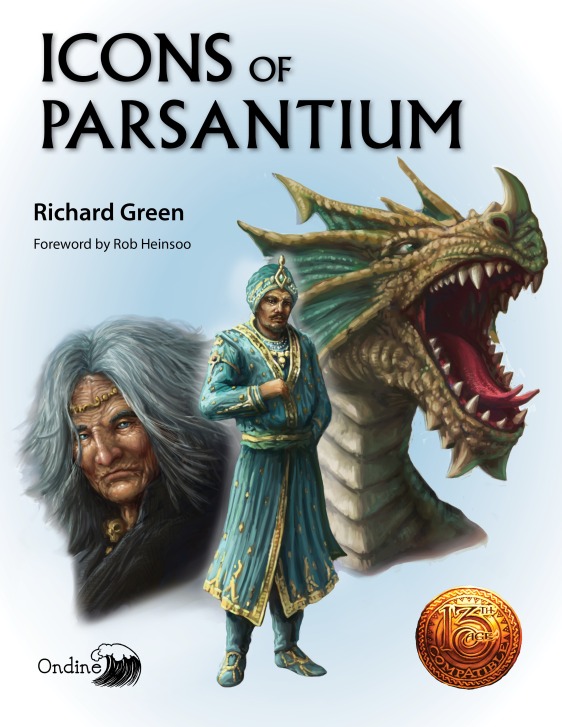
Rich Green was quick to bring icons to Parsantium, presenting them on his blog. Now by popular demand, he's collected them together into a single product, alongside some very welcome extras.
15 Icons for 13th Age
Pasantium's 15 icons give players plenty of villains to choose as enemies and allies to throw their lot in with. Many have obvious parallels with those within 13th Age; covering as they do obvious fantasy archetypes. The Basileus is analogous with the Emperor, for example, and the Lady of the Summer Kingdom parallels the Elf Queen. However, thanks to Parsantium's more intimate scale, we learn much more about Corandius XVIII than 13th Age's near anonymous Emperor. We learn that's Corandius XVIII is 'a short, stocky and physically powerful male human in his thirties, who conducts himself with a confidence that borders on arrogance, though he is handsome and charismatic enough to get away with it.' That kind of detail is much more engaging, which is what you want from an icon; icons need to hook the players in and encourage them to engage with the setting. Parsantium's icons do just that. They have personality in spades.
I think my favourite icon is The Mummy - awakened evils are always a favourite of mine! Hunting down (and/or trying to prevent them falling into her evil hands!) ancient artefacts could lead to some fun pulp adventurers.
Parsantium is a melting pot, and its icons are a varied bunch too, many representing the leaders of the regional powers and threats outside the city. As links to cultures they are evocative. These interests all want their piece of Parsantium's pie and they give players plenty of ways in to the intrigue within the city. They also offer plenty of opportunities for action beyond the cities borders, perhaps protecting caravans from gnoll raiders loyal to the Khan, or investigating evil-doers for the Platinum Knights. Speaking of which, I liked the world map that helped put the city's place in the world in context. Now I really want to go on expeditions!
Races
I was pleased to see two races that I felt essential to playing in Parsantium included - the gnoll and the vanara. The gnoll of course has always been a staple of D&D, and usually in a villainous role. Having them as potential violent and feral sell-swords is a neat option.
The vanara are monkey men; nosy and with a predilection for pranks. In the right hands they should make fun characters.
Of course, races in 13th Age lack the depth of other systems, usually only having a single racial power and a stat adjustment, so these races could have been cobbled together by enterprising groups. There's something to be said for 'correct' rules, however, so I'm grateful to see them.
Icon Relationship Ideas
After the icons is a section full of sample icon relationship rolls, at least four for each icon (Positive 5 or 6 and Negative 5 or 6). Thinking up new and interesting ways to use involve those icon dice is one of the most challenging aspects of 13th Age, so I really enjoyed reading through these, both to use them in Parsantium and just generally for ideas in my other 13th Age games.
I really liked the format these took too - most 5s were simply an additional complication to the more broadly positive 6. As I find 5s far more difficult to work out than 6s, having these examples has been a great source of inspiration! For example, a positive 6 with the Grand Master of the Blue Lotus might find the party acquiring the use of a magical staff - but a 5 might add on top that an 'unscrupulous wizard belonging to the Fireball Club' finds out and decides he is more worthy of it than the party!
You could easily ransack these examples and use them as plot hooks too! The example above might lead to a fair few fun encounters if built upon, with the wizard going to increasing lengths to obtain the staff! (and what's so special about it anyway?) There's a lot here to get the ideas flowing in a pinch, and Parsantium was already rich in that regard!
Essential?
While the icons have been available on the Parsantium blog for a while now, they've been updated here and collected in a nice little package, with extra content. I'd definitely recommend it if you're planning to run 13th Age Parsantium - having the icons in one place is handy enough, both the races and icon roll ideas are nice to have and worth a look for a couple of pounds.
If you're not running 13th Age, you'll still find the information on the icons useful - powerful NPCs that vie in the background are useful to know about whether they're connected mechanically or not!
I viewed Parsantium through a 13th Age lens, as that was (and is) my fantasy RPG of choice (although 5e has got a look in now I've actually seen the books!), and in my heart the two are inextricably intertwined, having initially encountered both at the same time at a convention.
Rich Green was quick to bring icons to Parsantium, presenting them on his blog. Now by popular demand, he's collected them together into a single product, alongside some very welcome extras.
15 Icons for 13th Age
Pasantium's 15 icons give players plenty of villains to choose as enemies and allies to throw their lot in with. Many have obvious parallels with those within 13th Age; covering as they do obvious fantasy archetypes. The Basileus is analogous with the Emperor, for example, and the Lady of the Summer Kingdom parallels the Elf Queen. However, thanks to Parsantium's more intimate scale, we learn much more about Corandius XVIII than 13th Age's near anonymous Emperor. We learn that's Corandius XVIII is 'a short, stocky and physically powerful male human in his thirties, who conducts himself with a confidence that borders on arrogance, though he is handsome and charismatic enough to get away with it.' That kind of detail is much more engaging, which is what you want from an icon; icons need to hook the players in and encourage them to engage with the setting. Parsantium's icons do just that. They have personality in spades.
I think my favourite icon is The Mummy - awakened evils are always a favourite of mine! Hunting down (and/or trying to prevent them falling into her evil hands!) ancient artefacts could lead to some fun pulp adventurers.
Parsantium is a melting pot, and its icons are a varied bunch too, many representing the leaders of the regional powers and threats outside the city. As links to cultures they are evocative. These interests all want their piece of Parsantium's pie and they give players plenty of ways in to the intrigue within the city. They also offer plenty of opportunities for action beyond the cities borders, perhaps protecting caravans from gnoll raiders loyal to the Khan, or investigating evil-doers for the Platinum Knights. Speaking of which, I liked the world map that helped put the city's place in the world in context. Now I really want to go on expeditions!
Races
I was pleased to see two races that I felt essential to playing in Parsantium included - the gnoll and the vanara. The gnoll of course has always been a staple of D&D, and usually in a villainous role. Having them as potential violent and feral sell-swords is a neat option.
The vanara are monkey men; nosy and with a predilection for pranks. In the right hands they should make fun characters.
Of course, races in 13th Age lack the depth of other systems, usually only having a single racial power and a stat adjustment, so these races could have been cobbled together by enterprising groups. There's something to be said for 'correct' rules, however, so I'm grateful to see them.
Icon Relationship Ideas
After the icons is a section full of sample icon relationship rolls, at least four for each icon (Positive 5 or 6 and Negative 5 or 6). Thinking up new and interesting ways to use involve those icon dice is one of the most challenging aspects of 13th Age, so I really enjoyed reading through these, both to use them in Parsantium and just generally for ideas in my other 13th Age games.
I really liked the format these took too - most 5s were simply an additional complication to the more broadly positive 6. As I find 5s far more difficult to work out than 6s, having these examples has been a great source of inspiration! For example, a positive 6 with the Grand Master of the Blue Lotus might find the party acquiring the use of a magical staff - but a 5 might add on top that an 'unscrupulous wizard belonging to the Fireball Club' finds out and decides he is more worthy of it than the party!
You could easily ransack these examples and use them as plot hooks too! The example above might lead to a fair few fun encounters if built upon, with the wizard going to increasing lengths to obtain the staff! (and what's so special about it anyway?) There's a lot here to get the ideas flowing in a pinch, and Parsantium was already rich in that regard!
Essential?
While the icons have been available on the Parsantium blog for a while now, they've been updated here and collected in a nice little package, with extra content. I'd definitely recommend it if you're planning to run 13th Age Parsantium - having the icons in one place is handy enough, both the races and icon roll ideas are nice to have and worth a look for a couple of pounds.
If you're not running 13th Age, you'll still find the information on the icons useful - powerful NPCs that vie in the background are useful to know about whether they're connected mechanically or not!


