Showing posts with label Review. Show all posts

8/16/2015

Icons of Parsantium Review

Type of Hobby: Roleplaying Game (Supplement)
Number of Players: 3+
Authors: Richard Green
Publisher: Ondine Publishing
Price: £2.58
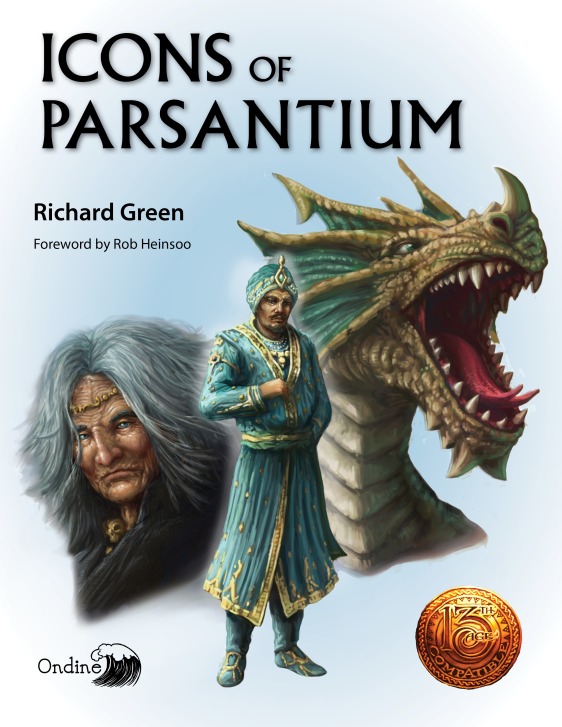
Icons of Parsantium by Richard Green

Disclosure: I received a copy for review from the author.

When I reviewed it last year, I was pretty impressed with Parsantium. I liked it's mash-up of historical and fantasy tropes; I liked that it was packed with detail; and I liked that it was cosmopolitan and varied.

I viewed Parsantium through a 13th Age lens, as that was (and is) my fantasy RPG of choice (although 5e has got a look in now I've actually seen the books!), and in my heart the two are inextricably intertwined, having initially encountered both at the same time at a convention.

Rich Green was quick to bring icons to Parsantium, presenting them on his blog. Now by popular demand, he's collected them together into a single product, alongside some very welcome extras.

15 Icons for 13th Age
Pasantium's 15 icons give players plenty of villains to choose as enemies and allies to throw their lot in with. Many have obvious parallels with those within 13th Age; covering as they do obvious fantasy archetypes. The Basileus is analogous with the Emperor, for example, and the Lady of the Summer Kingdom parallels the Elf Queen. However, thanks to Parsantium's more intimate scale, we learn much more about Corandius XVIII than 13th Age's near anonymous Emperor. We learn that's Corandius XVIII is 'a short, stocky and physically powerful male human in his thirties, who conducts himself with a confidence that borders on arrogance, though he is handsome and charismatic enough to get away with it.' That kind of detail is much more engaging, which is what you want from an icon; icons need to hook the players in and encourage them to engage with the setting. Parsantium's icons do just that. They have personality in spades.

I think my favourite icon is The Mummy - awakened evils are always a favourite of mine! Hunting down (and/or trying to prevent them falling into her evil hands!) ancient artefacts could lead to some fun pulp adventurers.

Parsantium is a melting pot, and its icons are a varied bunch too, many representing the leaders of the regional powers and threats outside the city. As links to cultures they are evocative. These interests all want their piece of Parsantium's pie and they give players plenty of ways in to the intrigue within the city. They also offer plenty of opportunities for action beyond the cities borders, perhaps protecting caravans from gnoll raiders loyal to the Khan, or investigating evil-doers for the Platinum Knights. Speaking of which, I liked the world map that helped put the city's place in the world in context. Now I really want to go on expeditions!

Races
I was pleased to see two races that I felt essential to playing in Parsantium included - the gnoll and the vanara. The gnoll of course has always been a staple of D&D, and usually in a villainous role. Having them as potential violent and feral sell-swords is a neat option.

The vanara are monkey men; nosy and with a predilection for pranks. In the right hands they should make fun characters.

Of course, races in 13th Age lack the depth of other systems, usually only having a single racial power and a stat adjustment, so these races could have been cobbled together by enterprising groups. There's something to be said for 'correct' rules, however, so I'm grateful to see them.

Icon Relationship Ideas
After the icons is a section full of sample icon relationship rolls, at least four for each icon (Positive 5 or 6 and Negative 5 or 6). Thinking up new and interesting ways to use involve those icon dice is one of the most challenging aspects of 13th Age, so I really enjoyed reading through these, both to use them in Parsantium and just generally for ideas in my other 13th Age games.

I really liked the format these took too - most 5s were simply an additional complication to the more broadly positive 6. As I find 5s far more difficult to work out than 6s, having these examples has been a great source of inspiration! For example, a positive 6 with the Grand Master of the Blue Lotus might find the party acquiring the use of a magical staff - but a 5 might add on top that an 'unscrupulous wizard belonging to the Fireball Club' finds out and decides he is more worthy of it than the party!

You could easily ransack these examples and use them as plot hooks too! The example above might lead to a fair few fun encounters if built upon, with the wizard going to increasing lengths to obtain the staff! (and what's so special about it anyway?) There's a lot here to get the ideas flowing in a pinch, and Parsantium was already rich in that regard!

Essential?
While the icons have been available on the Parsantium blog for a while now, they've been updated here and collected in a nice little package, with extra content. I'd definitely recommend it if you're planning to run 13th Age Parsantium - having the icons in one place is handy enough, both the races and icon roll ideas are nice to have and worth a look for a couple of pounds.

If you're not running 13th Age, you'll still find the information on the icons useful - powerful NPCs that vie in the background are useful to know about whether they're connected mechanically or not! 

7/21/2014

Thoughts On... 13th Age Bestiary

Type of Hobby:  Roleplaying Game (Supplement)
Number of Players: 3+
Authors: Rob Heinsoo et al
Publisher: Pelgrane Press
Price: £24.95 RRP


No RPG supplement excites me as much as a good monster manual. I'm certainly drawn to buy them whenever they come out for any system. I love flicking through the pages, searching for plot hooks and how and where I can use a monster in an adventure or two. I have so many that I'll never find time to use all the monsters I love.

That hasn't stopped me buying the 13th Age Bestiary, however. On the contrary, I've been waiting for my hardback copy with baited breath since I preordered it back in March. I've had the PDF, of course, but that's never the same.

If there was one aspect of the 13th Age Corebook that was disappointing, it was the section on monsters. Although they were mechanically interesting, information on them was limited to merely a sentence or two and there was no art representing them either. The Bestiary seems to have been in direct response to that, and the response is superb.

The Bestiary contains write-ups for 52 monsters, most of which have several variants, taking the total over 200. There's a lot of material here, all held together by the brilliantly simple mechanics that govern 13th Age's monsters and the open ended Dragon Empire. It's really good.

Monsters: You Can Never Have Too Many

The Bestiary fills in some important blanks that make up the staple of D&D monsters - ettercaps, chuuls and genies just naming a few. As expected from 13th Age, each of these contains a twist on the concept. Ettercaps are hoarders of secrets, though they still retain their affinity to spiders; genies are subject to a pact with the icons, able to interfere in the world for a time but that comes with the price of servitude; and chuuls are still lobster like aberrations, but they also lay eggs that can be cultivated into weird symbiotic magical items. All of this information is delightful and how much of it you use is up to you. It's nice to have these fresh takes on old ideas, allowing me the choice of presenting the 'classic' vision outlaid in various D&D sourcebooks over the years or put a new spin on things by taking some of the new flavour from these entries.

There are plenty of new monsters in the book too (at least to me), from the deadly and seductive jorgumo, the fourth wall breaking redcaps and clockwork zorigami, again, naming just a few. Each is just as brilliantly realised as these writeups for the more traditional monsters and they're all just as mechanically interesting. I particularly like the redcaps - there's something incredibly devious about the way their 'bad word' breaks the fourth wall (and I won't spoil it for you!)

Also unexpectedly slipping in is the 'twygzog' player character race, nestled within the entry for fungaloids. I wasn't expecting to find this at all. The idea of a humanoid mushroom prince cut off from the overmind is quite interesting, and has some nice roleplay potential. I'm not sure I'd play one myself but it's a cool option that players looking for a quirky and different race will appreciate.

You'll also find some expanded options for some of the most well known D&D monsters. Both white, black and red dragons get a lot of love, as do the drow. These are the kinds of monsters you'll be using again and again in your games, so having more options will never go amiss.

The monsters all show off how brilliant the way 13th Age handles monsters is. As a DM, I really appreciate how you only really have to worry about whether a monster is using its attack against enemies engaged with it or not. Letting the dice roll decide what else the attack does frees up my mindspace to think about more interesting things and improvise more entertaining descriptions. Having monster abilities trigger in this way also means that there's innate variety in the way monsters behave, and because it's inherently unpredictable it keeps players on their toes. I really like 13th Age's monsters.

Detail, so Much Detail!

Each entry is filled with wonderful detail. Completely opposite to the Corebook, each monster is given at least a few paragraphs of description before moving onto the individual monsters themselves. Even there, many of these monsters are given full writeups themselves. There's a lot to get your teeth into in these alone, inspiring adventure and encounter ideas.

Each entry also has a full colour artwork accompanying it and, although the art style is not to my personal taste, it's nice to have something to show the players to get their imagination going.

Alongside a description, monsters also come with advice on building battles (great when you're in a rush and just want to build a quick encounter), how they may or may not relate to the icons and a list of adventure hooks (again, great for when you're just looking for a quick idea to get the imagination going!).

Many come with even more than that, with quirky lists of sample loot and other esoteric elements. Ettercaps a list of secrets they keep, fungaloids come with sample environments, and death plague orcs come with example diseases and accompanying rules. Little bits of flavour fill this book from brim to brim, making each entry more than just a simple stat block and picture. You couldn't ask for more from a monster manual.

All this detail has really sold me on the Dragon Empire too. Seeing how its denizens live within it and add to it, as well as the myriad plothooks and ideas within this book, has really helped to set it apart and give it the depth it needed for it to interest me. It's still so entirely open ended that I could, if I wanted, do almost anything I wanted with it. And because everything is written in such an open way I can just cherry pick the appropriate ideas when I'm running something not set in the Dragon Empire.

How to Make a Monster

Right back at the beginning of the book is a set of 'Odd Monster Lists' that might come in handy. They're quite fun to read and, although quirky, are actually really useful. 'Monsters That Cloak Themselves in Lies' is a favourite.

At the end of the book is a great guide to monster creation. Working up from simply reskinning a monster, to tweaking one to be more suitable to your purpose and, the real meat of things, actually creating a monster from scratch. Here monster creation is broken down into two main areas - attacks/abilities that use the d20 and those that use the escalation die. The d20 section comes with a great list of triggers for effects to work from, including some of which that might not have occurred to me otherwise, like using the players ability scores as triggering numbers. (For example, to see if a player contracts a disease, see if the attack roll beats his ability score). I'll definitely be referring to this advice when I make my own monsters.

The Monsters That 13th Age Deserved

Artwork aside, this is everything I want in a monster manual. I've really enjoyed using the monsters I've picked so far and I can't wait to try a few more out. The amount of detail given means they're more than just stat blocks to kill the players with too, you can really build adventurers and stories out of any of these.

If this is the standard the sourcebooks for 13th Age are going to be hitting then I think the game is going to be going to some great places. I'm really excited.


7/09/2014

Thoughts On... Dungeons & Dragons (5e) Basic Rules

Type of Hobby: Roleplaying Game
Number of Players: 3+
Authors: Mike Mearls, Jeremy Crawford et al
Publisher: Wizards of the Coast
Price: Free! 

D&D - Reincarnated or Resurrected?


So, six years later, here we are again. And I mean that both figuratively and literally, for this edition of Dungeons and Dragons is both brand new and everything we knew. It's also free, in a basic set of rules that anyone can download. This is a smart move, I think; I know a lot of people have been on the fence, or even outright hostile, about this edition and letting people just look at what things are going to be like for free will at least let Wizards of the Coast put their hand on the table. So, go on, download them, have a flick through. You might like what you see!

What you'll find is an edition that has gone right back to AD&D 2nd Edition for inspiration, whilst in many ways being almost a complete revert back to the 3rd Edition. Aside from a few little touches, 5th almost completely ignores 4th Edition, giving it no legacy at all. That isn't to say that there are no modern features, but this is a game steeped in nostalgia.

I'll try to reference my current love, 13th Age, as little as possible, but in some places comparison between these two contemporaries is inevitable.

A Lot of Character

Character creation is largely incredibly familiar and full of surprising amounts of detail despite being a set of 'basic' rules. You see this immediately in the writeups for the races. There are only four in this document, the stalwarts of humans, dwarves, elves and halflings, but there's a lot to get your teeth into. Physical descriptions, descriptions of culture; there are even descriptions of how each race views the others. There's more to get your teeth into here in this basic document than there is in the entire 4th Edition or 13th Age core book. This is a game that desperately wants to reclaim the title of roleplaying game.

Still, I actually think there might be a little too much detail here, having five or more things you need to keep track of just for your race could lead to a little too much bookkeeping, or at least things being forgotten at the table. In most cases I love detail, but there's a lot of mechanics attached to these races.

The classes (fighter, cleric, rogue, wizard) are also very classic feeling and offer few surprises to D&D veterans. There's a nice customisation option available to each class, allowing you to take each one down a specific path (martial archetypes and arcane traditions, for example). It's nice to see each class have different options, but this does feel a bit limiting and reminiscent of the worst parts of 4th editions class builds. I'd like to see more mix and match abilities, like the talents in 13th Age, so that you can truly make your character your own.

I initially had some concerns that we had returned to the bad old days of the all powerful spellcaster, but a quick look at the math suggests to me that a fighter or rogue should be able to keep apace of the Wizard or Cleric, especially as those classes have returned to a more or less vancian system. That's an improvement over 3rd, certainly. That's not to say that the spellcasters aren't considerably more versatile and in that respect powerful; spells still exist to counter almost any situation the wizard might find himself otherwise deficient and with more spells promised in the Players Handbook, that might get worse. Of course, that same book is going to have lots more options for the humble fighter too! I'd have to see a party in play myself over a reasonable period of time to really see how it works out, but my first impression is that party balance is not as bad as D&D has been in the past, but not as good as it was in 4th Edition. However, that balance in 4th came in the form of class homogenisation, which many really hated.

There are some nice innovations in character generation - or at least, innovations for D&D. 5th Edition asks you to make some choices about your character's personality and history, some quite interesting, some less so.

I like the idea of choosing an ideal; something your character strives for, it's a nice idea that gives the player somewhere to go with the character right out of the box. It also gives the DM something to work with, something to tailor adventures and encounters to his players desires. That's really good.

I also like bonds, something your character is connected to in the background. They're like a very basic implementation of the Icons from 13th Age. It's another tool for the DM to work with, another important fact he can work into the story to help the player feel more connected. I'm always in favour of that.

Less interesting to me are the ideas of personality traits and flaws. Personality traits are just fluff that reminds the player to roleplay. It's useful for new players, but most experienced players are either going to roleplay character traits or they're not. And flaws seem out of place in an ostensibly heroic game, but that's just a personal taste thing.

The mechanic that drives all these myriad traits is inspiration. When you're inspired you can choose to claim an advantage on an attack roll, skill check or ability check.  A DM rewards inspiration when you play your character well according to the traits you've written down on your sheet. In this respect it's quite similar to nature and demeanor in old World of Darkness. I worry that this mechanic may simply reward more extroverted players and leave quieter players in the dark. Weirdly, you can choose to reward your own inspiration to another player, in lieu of the DM doing so. I have no idea when a player would willingly give up their own inspiration though - surely if a player is deserving of it, the DM should be rewarding it?

I like these things, even if they're not as decisive and exciting as the similar ideas in 13th Age. They just feel a bit forced in places, almost a little out of place or like an afterthought.

Tying these personality traits together are backgrounds. They do remind me a little of the old kits from 2nd Edition, but without any real mechanical benefit they're just a collection of sample personality ideas. Which is fine, but I'd like a little more crunch here.

Alignment is back, although it just feels like a strange concession to the past. Without the mechanical crunch of detect alignment spells, it's just a strange and outdated personality compass. I think they'd have been insane not to have included alignment, but it's something they seem almost frightened of implementing properly, which is almost understandable considering the controversy the idea has attracted over the years.

The last element of character generation to discuss are skills. They're terrible, and that's really the kindest thing I can say about them. They're pared down like in 4th Edition, but in an edition of resurgent detail they're utterly lacking. Nothing about this incredibly basic list excites me at all or makes me think 'Yeah, that would be a cool thing for my character to be good at!' After the exciting and liberating backgrounds of 13th Age I find it hard to look at these without total disappointment.

Lastly, although the rules for it are not available in the basic rules, multiclassing in the style of 3rd Edition has returned. I've always been torn about the 'take a level of this, a level of that' approach, as it intrigues me mechanically but narratively it's often a nightmare, especially if you feel you have a strong concept for a multi-classed character from the get go. It's a part of D&D history though, and it's tried and tested. I expect a lot of fans will be glad to see it back.

Equipping Yourself

There's an awful lot of things your character can buy in this basic document, covering everything from adventuring gear to the cost of boats. This is all classic D&D stuff and it's nice to see it returning, although the lifestyle expenses rule seems like an exercise in bookkeeping that most will skip. I've always liked the idea of making everyone keep accurate track of their money and, while its nice that this can be simplified down like this, by the time you're a high level adventurer whether or not you've spent 1 or 4 gold at the inn seems a little irrelevant. This is a problem that D&D has always had, however - and it won't stop me loving to hand out treasure to my players.

Your weapons and armour are the usual fare, with weapons being priced as seems historically accurate and given appropriate damage dice. The same seems to apply to armour. This is traditional. but now since being spoiled by 13th Age's abstraction here, I don't think I could go back. It seems absurd to me to have options that are simply not as good, putting players off taking what they think might be thematically cool. I suspect most players will simply gravitate towards the weapon that does the most damage. On the other hand, I wouldn't expect D&D to take such a radical step as abstracting weapon damage, as much as I might prefer it.

Running the Game

Throughout the basic rules pdf the rhythm of play is spelled out in very simple terms, and in a way I've never seen before -

  1. The DM describes the environment.
  2. The players describe what they want to do.
  3. The DM narrates the results of their actions. 
This is of course, really simple. For new players though, ones who have never roleplayed before, this could be a godsend. All too often games designers write paragraphs and paragraphs trying to explain what a roleplaying game actually is, usually supplying long examples, but this just puts it in the most simple terms possible. I really like this.

Running the game otherwise is more or less standard d20 D&D, which veterans will be utterly at home with. It still works. By default though, Wizards of the Coast have taken the brave choice to make combat gridless. Not mapless, but definitely gridless. (although the grid is an option). This harkens right back to the 2nd Edition and earlier. However, the level of detail and reliance on exact distances in this latest edition of D&D might mean that the grid is still very useful - just as it was in 2nd edition, even when it wasn't a core part of the rules.

Another core mechanic, which I really like for its simplicity, is advantage/disadvantage. If you have advantage, you roll two dice and take the highest. If you have disadvantage, roll two dice, take the lowest. It's a useful tool for both the game designers in designing abilities and DMs, who can use it to simply adjudicate situations. Fighting at the top of the stairs? Advantage! Fighting whilst on a swinging chandelier? Disadvantage! Dynamic and simple, this mechanic is really great.

It's D&D!

Overall all there is to say about these basic rules is that it's D&D. You're not getting the full experience, as I'm sure the Players Handbook will come with the rest of the classic classes and races, but you're getting the core experience. And I like it, for the most part. I'd definitely play it if someone chose to run it in my group, and I think I'd have a great time. If nothing else, reading through the pdf was making me incredibly nostalgic and I expect that's exactly what Wizards of the Coast were going for. If you want to play D&D, you could do a lot worse than this. On the other hand, because it's just nostalgia D&D I could just pick up my old 2nd Edition or 3rd Edition books and play or run from those, and I'd get that same effect. A few nifty mechanics and problems fixed won't change that. Certainly it hasn't usurped 13th Age as my fantasy game of choice with this pdf because it simply doesn't feel brave enough or different enough. Personality traits and inspiration are nice mechanics, but I've been spoiled now by the One Unique Thing and Icons. Nothing in these rules come close to those as tools a DM can use to craft great, player driven, campaigns. 

Where 4th Edition D&D felt radical and new, this simply feels nostalgic. 3rd Edition felt like it was trying new things and fixing old problems, whilst staying true to the feel of D&D. 5th Edition does neither of those things - it just feels like a minor rules update to 3rd Edition - and I think that might be a problem for Wizards of the Coast. That game already exists; it's called Pathfinder.

7/03/2014

Thoughts On... Warhammer 40,000 - 7th Edition

Type of Hobby: Miniatures Wargame
Number of Players: 2
Publisher: Games Workshop
Price: £50

The Latest Grim, Dark, Future
Comes in a fancy sleeve. Fancy.
I've been playing Warhammer 40,000 since the mid 90s and the second edition of the game so it's somehow very strange to be writing my thoughts on the seventh edition of the rules. Nonetheless, they arrived a couple of months ago after a very short gap since sixth of just less than two years. 

I don't think anyone was expecting a totally new direction after such a short hiatus, yet this is more than just a simple rules tidyup, with massive changes to the way the Force Organisation Chart works, alongside a new Psychic Phase and a new set of missions with variable objectives. 

Three Books for the Price of... Uh... Well...

It's impossible to let a Games Workshop product escape discussion without some talk of its price and the steep £50 price tag attached to these books certainly merits comment. It's only been two years since sixth edition and that book wasn't cheap. I think being expected to spend another £50 on the game, albeit in the form of three very pretty books, is a little cheeky. Worse, I think £50 is a very high addon to a game that, due to the high price of miniatures, paints and other hobby things already has an incredibly high price of entry. Still, this is par for the course for Games Workshop and most of us have come to expect it, even if we're not happy about it. I don't know what it would take to change this that wouldn't be incredibly destructive to the company which, despite it's flaws, I still love dearly.

One, two three!
For your £50 you get three books, each about the size of the Space Marine Codex. They're full colour hardbacks, which has been the standard for Games Workshop for some years now. They're full of beautiful pictures and artwork, which is something Games Workshop has always excelled at. If nothing else, you at least feel like they may be coming close to being worth the cost. 

Number 1 is 'A Galaxy of War' - this is the book that contains all the hobby information that was previously in the back of the rulebooks. It features an introduction to the hobby; the trio of painting, background and playing and finishes off with photographs of the 'Eavy Metal painted miniatures from the studio, which are always nice to flick through. I enjoyed this a lot more than I expected, and I think anyone new to the hobby coming across it would be suitably excited by what they've gotten themselves into.

Number 2 is 'Dark Millenium', which contains all the background contained in the previous rulebook, along with some new stuff. It is, sadly, mostly reprinted but it's a perfect primer for someone new to the game and setting. 

Number 3 is 'The Rules', which is where most of the attention will go for the majority of people and where, shockingly enough, you can find all the rules to play the game.

The most interesting thing about the use of three books is the order they are numbered in. Hobby first, background second, and game last. This says a lot about how Games Workshop views their product, and how they'd like it to be perceived. While presenting the hobby aspects and the background over the rules is admirable, I wonder if there's a disconnect between what gamers actually want and how Games Workshop is selling their product. This seems especially relevant with the recent rise of pre-painted and/or pre-assembled miniatures games like X-Wing and Dust Tactics. Perhaps this reorganising of the content is a reaction to that, an attempt to sway things back the other way. 

The New Grimness

Lost in the warp since '98!
The single biggest change is the (re)introduction of the Psychic Phase. It's nice to see that it isn't just a copy and paste of the Magic Phase from Warhammer Fantasy Battles, although I wouldn't have blamed them if that had happened! Instead you're trying to get a 4+ on at least one of your dice for each warp charge point the power costs to cast (usually one or two). You generate the amount of dice you have to play with in your pool randomly, but also get a dice for each level of Mastery of your psykers. Powers can be denied in a similar way. It's not over complicated, but there's enough nuance there that there's potential for interesting decisions in game. That's all I ask for, really. It's certainly more robust than the rules were before, which I always felt never really did psykers justice. They're a big part of the 40k lore and its great to see them put back in the limelight. 

Alongside this new phase is a new lore - Daemonology. This is a twin faceted lore with both Santic and Malefic powers. The Santic powers are mostly for use by the Grey Knights, although most can take them at a cost and they're filled with buffs and powers designed to defeat daemons. They're cool, but not really interesting. It's the Malefic powers where things get exciting - and more than a little bit heretical.  The Primaris Power is 'Summoning' and is a foul ritual that allows you to summon forth heinous Daemons from the warp. The rest of the powers are similarly sacrilegious, with terrible effects. One even lets you sacrifice your psykers very soul to summon a terrifying Greater Daemon. What's fascinating about this lore is that it's not the exclusive domain of the evil powers; almost anyone with a psyker can choose to take these powers. I've seen many cry foul at this, but using evil to defeat evil (and the risk that accompanies this act) is a key part of the Warhammer 40,000 setting for me. It's something that was explored in depth in the brilliant Eisenhorn trilogy by Dan Abnett and being able to struggle with those same questions on the tabletop is going to create a lot of exciting games at my table. 

Another much talked about addition to Warhammer 40,000 is the Maelstrom of War missions. All the previous Eternal War missions are still there, but it's these six new missions that really add something interesting to the game. They remind me a lot of the old second edition mission cards. Using a 'deck' (you can buy an actual deck, or use the d66 table in the book) of objectives, which change throughout the game as you complete them. I'm a fan of the idea, as it creates dynamic and unpredictable games. Unfortunately, the execution isn't perfect. Firstly, the 50% of the objectives are identical, which is a real shame. They're the ones that deal with taking points on the table. A roll of 13 to 'Capture and Control' objective 3 should, in some way, be different to a 33 to 'Storm and Defend' objective 3. The Ork Codex has revealed that each race will, in time, get their own deck of Tactical Objectives so I'm hopeful that eventually this problem will sort itself out. There's also the risk that one player could get a string of objectives that he simply can't complete (either through them actually being impossible, like harnessing the warp without having a psyker; or because they're unreasonably difficult, like taking an enemies objective the other side of the board) whilst his opponent gets away with really easy objectives. Law of averages says this should even out over time, but it's going to be an occasional frustration. Again, I'm hopeful that the faction specific decks will fix this, but it's a problem that should have come up in playtesting and shouldn't be there in the first place.

Warhammer 40,000 has also done away completely with the Force Organisation Chart! Well, almost. You now have to choose between an Unbound army, which can contain anything you want (subject to some restrictions on the Allies Matrix), or a Battle-forged Army - which is subject to the old FoC and gets some pretty nifty bonuses. Firstly, you can reroll on the Warlord table of your choice (which are all much more useful than they have been previously!) and, crucially, your troops choices can hold an objective against anything except Battle-Forged troops. That's a great way to keep troops important to a list - especially seeing as everything scores again now. 

There's a lot of potential for fun lists with Unbound, although I think you need to be careful that the benefits outweigh the cons. As a Space Wolf player, I'm sorely tempted to put a Leman Russ or two into my army. Seems fitting and I miss them. 

Lost in the Warp?

Where have you gone?! 
There are notable casualties in this latest edition of Warhammer 40,000, however. Where have the Fortifications and Mysterious Terrain gone? I liked both of those things! Fortifications live on in Stronghold Assault, but taking them out of the core book still seems cheeky to me. Guess my Aegis Defence Line is just terrain now.

Losing Mysterious Terrain is an omission that I suspect a lot of (dull) people will be pleased about. My group will be coming up with our datasheets for these, I think. I felt they added a lot to the game, an air of uncertainty that was interesting to play around with. I think they needed more beneficial elements, and probably a higher chance to have nothing unusual happen, but the idea was solid.

A Billion Changes, Across A Billion Worlds

There's lots more, smaller, tweaks throughout the book. And some bigger ones - Lords of War are now part of standard games now. So bring that Baneblade. I like a challenge. 

Ultimately, though, the game is still the same sort of Warhammer 40,000 we've had since third edition came out in '98. Which is fine. I'm not sure it's worth £50, though. At least most of the changes are good, it's just a shame we've had to pay so much, so soon.

Oh well. Anyone fancy a game?


6/19/2014

Thoughts on... 13th Age

Type of Hobby:  Roleplaying Game
Number of Players: 3+
Authors: Rob Heinsoo, Aaron McConnell, Lee Moyer, Jonathan Tweet
Publisher: Pelgrane Press
Price: £29.95 RRP


13th Age is what you get when two industry stalwarts; Jonathan Tweet, lead designer of 3rd Edition D&D; and Rob Heinsoo, lead designer of 4th Edition D&D, team up to create the fantasy roleplaying game that they want to play. Comparisons to D&D are inevitable - this is D&D in everything but name.

D&D players of all editions, but particularly 4th, will find a lot they recognise in 13th Age. Yet, there are several elements that set this game apart from its spiritual predecessors; the icons; one unique things; backgrounds; and the escalation die. Each of these ideas helps bring story to the focus in a game that is still, in its heart of hearts, still a dungeon adventure game in the spirit of D&D. 13th Age tries to be the best of all worlds; perhaps the ultimate fantasy RPG. And largely, it succeeds.

Iconic Fantasy Roleplay

The most important concept in 13th Age is that of the icons. So much so that the first thing in the book is the icons, before character generation and long before any other background is given. These thirteen powerful NPCs represent instantly recognisable archetypes - the High Druid, the Orc Lord, the Dwarf King, to name a few - that every character will tie themselves to. 

Players will often find that the DM has written a wealth of background material; but they find it hard to connect their characters to it and find ways to invest themselves in that world. That can be frustrating for both sides. Icons instead connect players to the world from the start. As a part of character generation assigning which icons your character is allied, or enemies, with immediately invests you in the world and lets the DM know exactly what you, and your character, want from the game. 

This works brilliantly as a storytelling tool - icons give characters motivation, and let's the DM tailor the story to your needs. And as icons are more than just a single NPC - they represent a whole network of power - there are myriad options and opportunities for the DM to get them involved and to shape the game around how the players interact with them. 

Yet even more so than this, there is also a storytelling mechanic at play here. At the beginning of every session the DM calls for the players to make story guidance rolls; one d6 for each point invested in a given icon - and for every five or six on a d6 that icon will be involved. This does require the DM to be confident in improvising, but there is massive leeway in terms of scale. The effect can be as simple as the agents of a heroic icon gifting the player a magic item to help them on their quest - or as complicated as a villainous icon becoming the sessions main antagonist.

Icons could easily have become powerful NPCs that dominate the game and take away from the players - a la the worse aspects of the Forgotten Realms - but instead they facilitate players stories and provide motivation. They're a game changer.

Truly Unique Characters

13th Age's character options will for the most part seem very familiar to fans of D&D. The standard assortment of dwarves, elves, halflings and such are there; along with a few more esoteric optional races for fans of various editions and settings in D&D such as the dragonborn dragonspawn. So far so D&D.

The classes available are also standard D&D fare. Each offers a unique playing experience with its own subtle twist on the mechanics. Rogues strive to keep up momentum, while sorcerers must choose whether or not to spend a turn building up power for more powerful attacks, and fighters are incredibly flexible. Even within these classes there are several options; each class picks at least three talents from a set of options. It is unlikely that two rangers, for example, would be the same in a group. Best of all these choices are nowhere near as restrictive as 4th edition D&D's character builds, meaning that there is a lot of flexibility in building your character. Given all this it's a shame that the druid class is missing from the core book, but it is going to arrive in a coming supplement.

Characters are allotted one feat per level - which means most will have 10 by the end of their careers. 13th Age has very few feats that might be considered traps; there are only a couple that do not play directly off of a spell or talent. There is a move away from a 'feat tax' too; you won't find any feats that simply give a +1 to hit! 

Beyond the mechanics, characters must come up with One Unique Thing. Alongside the icons this is another element of the game that helps flesh out characters from the off. The OUT can be anything, as long as it doesn't give require a mechanical benefit. Examples range from the mundane ('I really like grapes') to world changing ('I am the only paladin in the world'). 

Although it's just a single soundbite about your character these little, or not so little, details are great. They give the DM a vital bit of information that can help him build stories around and involving your character. It also helps the other players build an image of your character in their minds. At a demo game I played at Dragonmeet I was left in no doubt by the time we'd all come up with our Unique Things exactly who my party was. 

13th Age also eschews the traditional skill system for something much freer. Rather than a long list of skills, there are instead backgrounds. A background is a description of an element of your character. Rather than having to painstakingly work out how to allocate your skill points to best represent playing a Blackwater Assassin brought up on the streets by a dwarven scoundrel by the name of Buckfast Monkdrinker, you'd simply give yourself 5 points in Blackwater Assassin and 3 in Brought up by Buckfast Monkdrinker. Done. 

That freedom is incredible, and I fell in love with it at first sight. It does come with a couple of caveats, however; it requires a DM willing to make snap decisions about what a given background can be used for, and some discussion during character creation about what the player intends the background to cover. Even then if a player can justify it and it furthers the story a background should be able to cover a lot more than seems obvious at first. During one session a wizard with the 'library scholar' background justified using it during a stealth check because he was so used to trying not to make any noise while walking around the library!

Equipment is also extremely streamlined - characters don't purchase equipment during creation and simply choose what they want to wield from very broad categories. Some classes, such as the wizard, will find penalties if they're using a more martial weapon but what small weapon they choose to wield is up to them (although the book suggests a dagger) - they're still only doing 1d4 damage with it! (what are you doing trying to stab him? Zap him with a spell, you fool!) That same dagger, in the hands of a rogue, is going to do 1d8! While I think a lot of players will miss equipment lists, I've often felt before that they've really held back character concepts at the conceit of realism. No longer are warhammers the black sheep of the weapon options (1d4+1? What?) and no longer will a rogue feel he has to eschew the dagger in favour of the short sword to do more damage! 13th Age wants you to play the character you want to play. That's brilliant.

Just 10 Levels, But No XP

There are only ten levels in 13th Age, instead of the twenty or thirty of other d20 fantasy games. At first this might seem like sacrilege but in reality it fixes problems present in both 3rd and 4th edition D&D. 4th edition in particular suffered from severe options bloat - even by 15th level characters had pages of powers, and that's not including ones granted by magic items. 13th Age deftly avoids this by keeping the number of levels to 10. There is always just enough options, but never so many that you're overwhelmed by choice.

There are the three tiers of play, first introduced formally by 4th Edition D&D. Paragon tier has been renamed 'Champion' tier, though. These as much thematic as they are mechanical, and I think they're still a useful tool for the DM to let him know roughly what the scale of threats and types of locales should be.

13th Age also puts when you level up squarely into the DM's hands. Many DMs over the years have chosen to simply level up when it seems appropriate to the story and 13th Age embraces this philosophy. XP might have been a sacred cow for some but in reality it was just another number for players to keep track of; in my experience, only a couple ever did accurately anyway. I don't miss it and I am grateful for the ability to control the speed of advancement in my game to something that suits the pace of the story.

With only ten levels and advancement at speed of DM, there is potential for stagnation, particularly if the DM favours a slow progression through the levels to better simulate the length of a traditional D&D campaign. 13th Age allows the DM to avoid this through incremental advances, little bits of your characters next level! Go on, take a spell, or a feat, or those hit-points; they're good for you!

The Grid is Gone!

Combat in 13th Age is everything I wished it was in 4th Edition D&D. It's fast, engaging, not a headache for the DM or the players, and you never sit there clock-watching hoping a monster will drop while everyone throws at-will powers at it ad nauseam. And yes, the grid is gone! And it's fine!

No grid doesn't have to mean no miniatures though - in fact I think I'd still recommend using them for clarity if you have more than a couple of players - but there's no more measuring things out in 5' increments or worrying whether a diagonal should count as one move or one and a half. There is of course maneuvering to worry about - you don't want to risk being intercepted when you charge in - but it feels much looser, more free form and actually, more realistic because of it. With imaginative players combat in 13th Age is very fun indeed.

Combat also showcases another of 13th Age's real innovations, something that solves problems that D&D has always had - the escalation die. This is a cumulative modifier that represents the heroes building up momentum and wearing their enemies down. Gaining an ever increasing bonus to hit every round means that combats avoid dragging on and on - by round seven you're getting the maximum +6 to hit. That makes a huge difference! It also helps discourage the alpha-strike - players are more inclined to hold off on their showy once a battle or day powers if they think they can get a better chance to hit later on! This helps the latter half of battles feel more climatic, rather than the drudge of simple attacks that was often the scourge of D&D. Most monsters don't get this bonus either - and players should certainly fear the ones that do! (Dragons do. Of course dragons do!)

Plenty of abilities play with it as well - some abilities become easier to use if you use them later, for example. I really like the escalation dice, but I think that some players might find the fact it's purely mechanical a bit of a drawback; there's no reason that it isn't mechanical for its existence, it exists purely outside the game world. However, the problems it solves and the fun ways you can play with it make it a worthwhile addition.

Monsters take a lot of inspiration from the stat blocks of 4th Edition D&D, which is great. They're vastly improved too, running almost on auto-pilot; the dice-roll itself tends to determine exactly what the monster is doing. For example, if a drider hits with its lightning bolt spell and the dice roll is even, it makes another attack as the lightning arcs from one enemy to another! This means the DM can concentrate more on what's happening in the combat and filling it with awesome descriptions and heroism, rather than worrying about exactly what his monsters are going to be doing. Anything that frees up my brainspace at the table is valued by me!

It's Not All Perfect

There are some things in 13th Age that either don't quite work for me. Full heal-ups are one of them. While simply saying you get all your stuff back every four encounters solves the problem of wizards with powerful daily powers being better than characters who do more consistent damage, I've found players often given me an odd look when I tell them they can't have their powers/recoveries back after an eight hour rest. As written, the rule works, and it encourages the players to keep pressing on rather than stopping and resting, but every so often it can break verisimilitude.

Monsters are tied to levels too, which is fine as a balancing mechanic and it's just as useful to be able to quickly select some and expect a roughly fair encounter, there's still the worry that players will expect battles to be fair, which shouldn't always be the case. I found that in 4th ed D&D a lot. Thankfully, the game is explicit that some monsters, dragons particularly, just aren't fair to fight so hopefully my players won't fall into this trap of thinking again.

I also wish there was a more robust system for treasure, and equipment in general. Treasure is just a flat system of x gold per player per full heal-up. I understand why they felt the need to move focus away from looting but it just feels tacked on  - and I miss treasure tables! Even the optional system only rewards potions and consumables, of which their are only a measly four different types to chose from! Earning money and having nothing to spend it on has been a problem for me in all editions of D&D and I'm really disappointed to see it made even worse here when the rest of the game is so imaginative.

These are all minor niggles though, ultimately, and I'm hopeful the community will come up with more treasure and that some more potions and consumables will appear in later supplements.

Too Hung-Up on the Dragon Empire

The book comes bundled with its own core setting, the Dragon Empire, from which the icons and all the background is derived. It's an interesting enough setting - I've enjoyed running in it - but quite deliberately generic. Honestly, I wish it wasn't there. I usually play in my groups homebrew setting and while the majority of the rules can easily be separated from the Dragon Empire some elements are much trickier; anything to do with the icons in particular. Irritatingly, this also impacts on some class powers, especially those of the bard and sorcerer. When I write my own icons I need to make sure that it's going to be simple to just switch the names around or I'm going to have to do some real work to make sure they still function.

If you're not running the Dragon Empire most of the description in the book is completely useless and just dead space.

I wish that the space devoted to the Empire had instead been filled with advice for DMs, as there's very little in the book. It would be really helpful if there was a section on creating your own icons, describing the core archetypes, offering alternate ones and how to mix the icons up and still keep the classes working. The icons are so utterly core to the game I think they deserved a section like this. The lack of this kind of information might make it somewhat off-putting for some DMs wishing to use different settings, especially those moving on from D&D to 13th Age. 

Having said that, the Dragon Empire does have a lot to recommend it. It's full of lots of hooks that are just vague enough for the DM to do whatever they like with them. It's clearly a setting designed for collaborative world-building and that fits the game perfectly. It's very well done, with some really interesting ideas, like the migrating behemoths that wander the land and living dungeons (which are a great way to fit in the utterly nonsensical dungeons that D&D is prone to!)

This 'do what you want' philosophy does hurt the section on monsters in the book though; most of them get barely a couple of sentences of description, and none of them have illustrations. That's probably the poorest area in the book. I think there's a lot of assumed knowledge there, which a new DM isn't going to have.

Magic - Rare, but not That Rare

It wouldn't be fantasy roleplay without some sort of magic items and this is very true in 13th Age as well. They are described as rare and precious and usually unique. Which is awesome! That's just what I want from my fantasy - the ten a penny magic items of 4th edition D&D were not for me. Unfortunately they're mechanically required and this mechanical requirement seems incompatible with the idea of magic items being rare. This is just a personal taste thing, however; it fits with the standard fantasy assumptions quite well.

Despite this though, I really like everything else about magic items in 13th Age. The default assumption is that they're all sentient, even if they can't directly communicate with you. Further, if you possess too many the whims and quirks of these items will overwhelm you, manifesting in often bizarre personality traits unique to the item. This is a great, and fun, way of preventing your players loading up on too many items! There is potential for hilarity when a greedy player, taking all the items meant for other players, suddenly finds those players describing his characters new, and often undesirable, traits! 

Something brilliantly freeform is how ritual casting is handled in 13th Age. Characters can use their spells to perform any logical effect - from using a fire spell to start a bonfire to using a hold portal spell to trap a demon inside a vessel. There are of course complications; the more complex the effect, the harder it is to do and the harder the components will be to find and the longer it will take! Particularly campaign changing rituals could even inspire subquests all of their own. I really like this; it lets spell-casters be as flexible as they probably should be, but the DM can rein them back in to make sure they can't simply solve any problem with a clever, outside the box, use of a spell, making everyone else look pointless and silly. Rituals can't be used in combat either (they take too long to cast, this doesn't mean a combat can't happen while you're performing one!), which limits their use somewhat and goes a long way to stopping spellcasters overshadowing anyone else. In combat the wizard is no more or less valuable than anyone else, which is how it should be.

I Hope the 13th Age isn't the Last

13th Age is a game that tries very hard to please everyone, but particularly players who want a more story focused game, rather than a complex tactical exercise. This suits my tastes perfectly, and I think there is enough depth in the mechanics for most players to get their teeth stuck into, if they want it. The game takes D&D away from simple dungeon crawling, killing monsters and taking their stuff, and acknowledges what most of us knew all along; these games are about the story, first and foremost.

I wish 13th Age wasn't so tied to the Dragon Empire, and I wish there were more options for treasure. It's not suitable for the beginning DM either (although it is very, very suitable for beginning players!), and it does openly acknowledge this. The focus on characters and story though is superb - this game gives DMs and players so much to work with in terms of creating a collaborative story and world. Icons mean the DM is never going to be frustrated that characters aren't engaged with the world again! One Unique Things will inspire some truly unique characters! 

13th Age is my fantasy game of choice for now. It's certainly going to be my favoured 'edition' of D&D for some time. I can't wait to see where it goes. 

6/08/2014

Thoughts on... Star Trek: Attack Wing

Type of Hobby:  Board/Miniatures Games
Number of Players: 2-3 (Officially) 4+ (In Reality)
Price: £29.99 RRP (Starter Set) / £11.99 (Expansions)

I am  a Star Trek geek. I'm someone who can tell you that a Galaxy-class starship has 12 Type X phaser arrays and  2 torpedo tubes (one fore, one aft), giving it near complete coverage and no real weak spots. I'm someone who can see a screengrab and be able to tell instantly the title of the episode, the season it's in and possibly, if I'm on a roll, the production number. I'm someone who can tell you what season an episode is from by Doctor Beverly Crusher's hair. 


Season 7, before you ask.

All this meant that Star Trek: Attack Wing was the most exciting thing ever. Fantasy Flight's X-Wing, only with my franchise of choice. I was, admittedly, unsure that the fighter on fighter gameplay of X-Wing would translate to the capital ship combat of Star Trek but, after watching some YouTube videos I was pretty convinced that this game was pretty great. So I bought the Starter Set, which was fun and seemed a pretty good proof of concept.

Core Mechanics


I'd already played the system in Star Wars: X-Wing, so I knew the ruleset was solid. The manoeuvre templates and dials worked really well to  create an exciting, dynamic feel. The system was, overall, fast, quick and easy to play, with the one action per ship economy creating some interesting choices in play. None of that has changed here. I was worried that the system, designed originally for  fighter planes in Wings of War, then again for fighter ships in X-Wing, simply wouldn't feel right for the larger, slower, Star Trek ships. For the most part though my concerns were proven wrong, although in some ways the designers have added in some strange balance issues, that X-Wing doesn't possess, due to a rigid adherence to some odd ideas.

The Starter Set comes with a whole bunch of stuff and it's just the tip of the iceberg.
The system has been adapted to Star Trek in some really cool ways. There's a greater focus on characters, with each ship having to chose a Captain and the majority of the upgrades being crew cards. Being able to assemble your dream team of ship, Captain, and crew is really a key part of the enjoyment to me as a Star Trek fan. Being able to make-believe what might have happened if Picard, or even Kirk, had got command of the USS Defiant is just so much fun that it's almost worth the price of admission alone.

Other upgrades include weapons and special technology and most of these mimic X-Wing pretty closely, although Attack Wing does have an ace up its sleeve here; disabling. Rather than simply discarding cards such as Photon Torpedoes, you can instead chose to spend your precious action on reloading, allowing you to keep firing. This gives even more depth to X-Wings action economy in a really cool way, with even more decisions to ponder, increasing the depth of the game.

Strange, Rigid, Design Decisions


That's the USS Odyssey firing backwards; it's not just the Enterprise that can do it!
Despite being a fan who can quote completely useless facts and statistics about Star Trek, I was prepared to be pretty easy going when it came to inconsistencies between the game and the show. The show itself rarely presented starship combat in a consistent way; as special effects technology improved over time, so did the nature of combat within the show. What begins in TOS and TNG as a pretty static affair soon evolved into a dynamic, fast moving, display of firepower. 

However, there are some strange decisions that I felt really hurt the game. There seems to have been some very rigid thinking involved in the design. The first thing I noticed, especially after buying a few expansion packs, is that almost all the ships have the same manoeuvres. This has the weird effect that a large cruiser ends up being more or less as manoeuverable as a small ship like the Defiant class. These same 15 manoeuvres are repeated over and over and I wonder why this is. Part of what makes the X-Wing ships feel so cool and different is each one moves in a totally different way. The Y-Wing is like taking your dads old Volvo out for a spin while your mates are throwing handbrake turns in their Tie-Fighters around you. It's really cool and fun and, frankly, the reason the system of dials and templates works so well. It's really unfortunate that it's only occasionally Attack Wing takes advantage of this, as it really makes the game feel bland in the movement stage. Some strides have been made here with the newest Borg ships, but it's too little too late and other ships are still coming out with these exact same manoeuvres. 

Another example of this rigid thinking is within the points costs of the ships. There's a very basic formula at in play - add up the stats, multiply by two - and it just doesn't work. It completely fails to take into account the special abilities of the 'named' ships like the Enterprise or the manoeuvre dials. I wonder if this is partly why the dials are all copy and paste jobs, to keep some strange balance with their devised formula. The game would have benefitted greatly from some diversity in this area, and individual points costs should have become apparent through playtesting. This a change from X-Wing which is definitely for the worse. 

There are some very odd choices being made in the firing arcs of the ships as well, which again I think is due to this rigid adherence to the formula. I wouldn't expect a fully 360° arc of fire from all the ships - although it could be done it would harm the manoeuvring aspect of the game which is so key - but some have been given a 90° arc when it really makes no sense at all. Why, of all ships, has the Galaxy Class been given a 90° arc? Or the Intrepid? Whilst others, like the Miranda and Constitution have much more reasonable 180° arcs. The Enterprise-D has the ability to fire 360°, which is great, but all that does is make the 90° arc on the generic Galaxy that much more incongruous. The effect of all these 90° arcs is to make the game feel less like you're firing capital ships and more like fighters. It seems odd that the design can hit the target with some of the ships, making the game feel just right, and not with others. 

You Can't Have All The Ships

Don't get excited - you can't buy this.

My favourite ship class by a long shot is the Nebula. I love how compact it is, and how it has cool looking torpedo pod. It's my favourite and I waited with baited breath for it's announcement in Attack Wing. 


I wish I hadn't.

Wizkids, in their wisdom, have decided to give some ships away exclusively as prizes in tournaments. Honestly, I think this sucks. It means that, short of going to eBay and spending silly money, you can't have a complete collection. Even if they were to release a Nebula Class in future (although there is still no sign of this), I know that the USS Sutherland and Captain Data et al will be forever out of my reach. This is particularly frustrating as a fan who just wants to collect all the bits of Star Trek lore and use them in the game. I think this is another area that X-Wing  beats it's Star Trek cousin in, as their prizes are just ships that are due to be released at a later date. That seems like a much better idea to me. 

Boldly Going...

Even this is just a small amount of the things you can buy! Seriously, there's a lot of stuff.
Star Trek: Attack Wing is a game that comes so very close to being the perfect Star Trek miniatures game. The diversity in cards, the fact that it vastly improves on some aspects of X-Wing mean that it should be great. Some strange design decisions and the fact that a complete collection is impossible for most means that I just view it as a missed opportunity. It's still fun, and worth a look if you love Star Trek. But it's just good, not great, and I think Star Trek is still looking for a game with as much care and attention as X-Wing. I hope it isn't looking for too much longer.